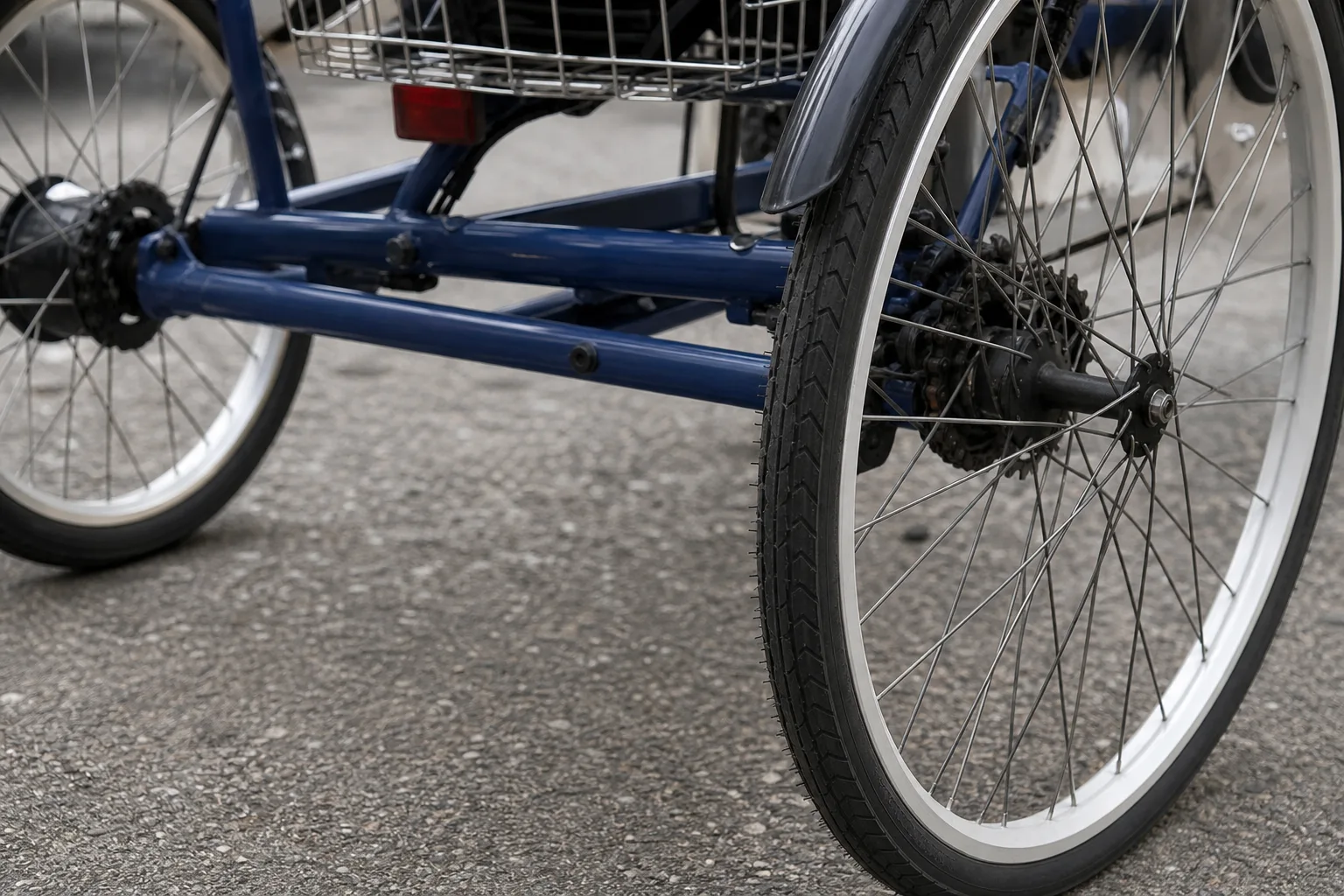
A working comparison of adult three-wheeled cycles, from unpowered delta trikes to hub-motor and mid-drive machines, put together by one rider before buying. Nothing here is for sale and no brand paid to appear.
A rider in her seventies, recovering from a knee replacement and living half a mile from a grocery store, gave up her upright two-wheeler after a slow tip-over in a driveway. She had not fallen while moving. She had fallen while stopped, one foot down, reaching for a mailbox, and the bike went over sideways at almost no speed at all. That is the failure mode that sends most people toward a third wheel, and it is worth being precise about it, because a trike solves that specific problem completely and several adjacent problems not at all.
The standstill problem is genuinely solved
Balance on a two-wheeler is dynamic: it comes from steering corrections that only work while the wheels are turning. Below roughly walking pace those corrections stop working, which is why the stop sign, the driveway apron, and the moment of dismount account for so many low-speed falls among older riders. A trike takes that away entirely. You can stop mid-hill, sit still at a red light with both feet on the pedals, unclip a grocery bag from the rear basket, and check a phone without putting anything down. For a rider with a fused ankle, a balance disorder, vertigo, peripheral neuropathy, or simply the reasonable fear that follows one bad fall, that single change is the whole purchase.
The load-carrying follows from the same geometry. A rear axle with two wheels supports a basket that does not have to be balanced, so forty pounds of groceries, a bag of soil, or a folded walker sits where it is put and stays there. Two-wheelers can carry that weight, but the loading and unloading happens against a kickstand, and the moment of imbalance is exactly the moment the rider is least prepared for it.
The costs are width, cornering, and camber
Adult trikes commonly measure somewhere around thirty to thirty-four inches across the rear axle, which is wider than a standard interior doorway once you account for the trim, wider than the gap between a parked car and a garage wall, and wider than the striped part of many bike lanes. That number decides more about daily use than the motor does. Measure the narrowest point on the route between where the trike sleeps and where it rides, and measure it before anything else.
Cornering is the second cost, and it is the one riders discover by surprise. A two-wheeler leans into a turn, which puts the combined force of gravity and cornering through the tire contact patch. A trike cannot lean. Take a corner at speed, or swerve around a pothole, and the outside wheels load up while the inside rear wheel goes light and eventually leaves the ground. Downhill turns are where this bites hardest, because the speed arrives without effort. The fix is not skill. It is slowing down before the turn, every time, which is a habit rather than a technique.
Camber is the third. Roads are crowned to shed water, driveways slope, and sidewalks tilt toward the gutter. A two-wheeler absorbs all of that in the lean angle and the rider never notices. A trike transmits it to the handlebars as a steady pull toward the low side, so a long stretch of cambered shoulder means constant light steering pressure. Riders adapt within a week or two, but wrists and shoulders feel it first.
Who should buy a two-wheeler instead
Plenty of people arrive at a trike because of saddle discomfort, difficulty swinging a leg over a high top tube, or nervousness about traffic, and none of those problems requires three wheels. A step-through frame with a low standover, a wide sprung saddle, upright bars, and a low bottom-bracket height solves mounting and comfort without adding a foot of width or removing the ability to lean. If you can stand over a bike, hold it upright at a stop, and walk it around a parked car without wobbling, the two-wheeler is the lighter, narrower, faster, cheaper machine and it will fit through the door.
The honest test is not whether riding feels hard. It is whether stopping feels hard. Anyone comparing options should also read what owners say after a year rather than a week, because the recurring complaints about a 3 wheel e bike tend to be about storage footprint, turning radius, and transport rather than anything to do with the ride itself.
What the decision actually costs
Beyond the purchase price, budget for the things a third wheel drags along with it: a storage space at least three feet wide with clear access, a hitch rack rated for the weight rather than a trunk rack, and possibly a ramp if the trike lives behind a step. Add the differential or single-drive-wheel maintenance that a bike shop may not routinely handle, and add the fact that a loaded electric trike can approach a hundred pounds, which changes who can move it when a tire goes flat. The Consumer Product Safety Commission is responsible for bicycle safety requirements in the United States, and reputable manufacturers build to those standards, but no standard makes a wide machine narrow.
Weigh it as a trade, not an upgrade. If the standstill is the problem, three wheels answer it outright and nothing else does. If the standstill was never the problem, the third wheel is width and weight you will be managing every single day.