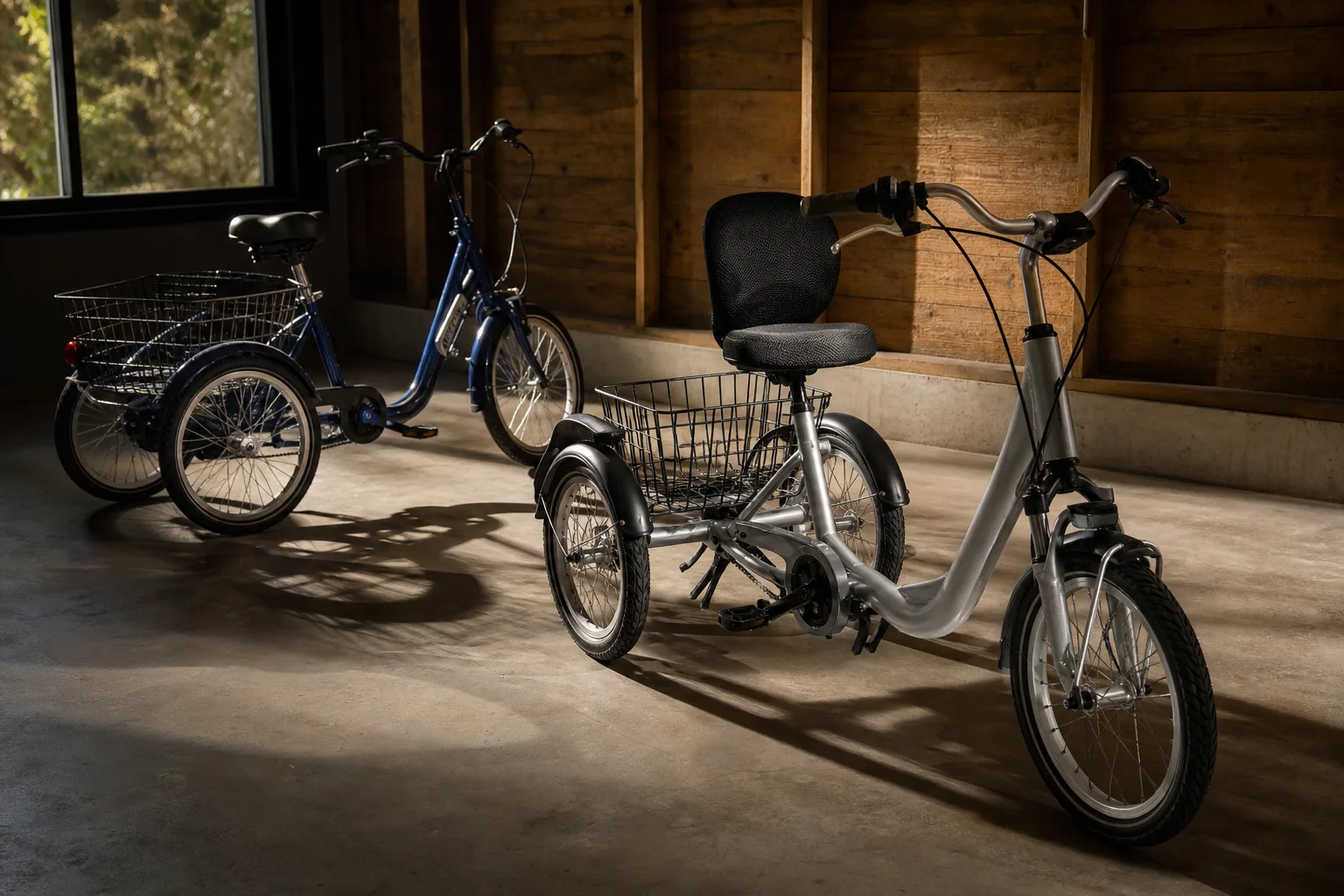
A rider testing an upright delta trike in a supermarket parking lot noticed something on the second lap that the first lap had hidden. Riding across the slope of the lot, with the drain running down the middle, the trike sat fine going one way and felt light on the uphill rear wheel going the other. Nothing dramatic, no lift, just a change in where the weight seemed to live. That single observation, made on a cambered surface at walking pace, is the one that separates the two families of three-wheeled cycle more usefully than any spec sheet.
Where the pair of wheels sits, and what follows from it
A delta puts one wheel in front and two at the back, and it is the shape most people picture: upright seat, high bottom bracket relative to the ground, basket over the rear axle. A tadpole reverses that, two steered wheels in front and one driven wheel behind, and it almost always comes with a reclined seat a few inches off the pavement. Neither layout is a refinement of the other. The wheel arrangement decides seat height, and seat height decides how high the center of mass sits, which decides nearly everything about how the machine behaves when the road tilts.
On the delta, the rider sits above the rear axle line, so weight transfers outward quickly in a turn and the inside rear wheel unloads first. On the tadpole, the mass sits low and forward, between the two front wheels, which is why a tadpole can be taken through a corner at a speed that would have a delta rider braking hard. The trade is access. Getting out of a low seat with the pedals in front of you is a different physical act than stepping off an upright saddle, and that is the part to test rather than to reason about.
Turning circle, and the parking lot test that reveals it
Deltas turn tight because a single front wheel can swing through a wide arc without anything fouling it, and a well-made delta will come around inside the width of a residential street. Tadpoles carry two steered wheels, tie rods, and often a wide track, and their turning circle is set by geometry that the frame builder fixed years ago. Mark two points on the ground, ride a full circle in each direction, and pace it out. Do this on the actual machine, loaded the way you would load it, because a full rear basket changes how willingly a delta comes around.
Solid axle or differential, and how to tell without a manual
Most inexpensive deltas drive both rear wheels through a solid bar, which means both wheels turn at the same speed even though the outside wheel travels farther through a corner. The result is scrub: a slight fight, a scuffed tire, and a machine that resists tight turns under power. Some drive only one wheel, which is quieter but pulls to one side on loose gravel. A differential splits the drive properly and costs more. Lift the rear of the trike, turn one wheel by hand, and watch the other. Same direction and speed means a solid axle. Opposite direction means a differential. No movement means a single driven wheel.
Camber, and the tipping behavior nobody demonstrates
Crowned roads shed water, and every crowned road is a permanent sideways slope that a two-track vehicle feels and a bicycle does not. On a delta, riding along the crown puts more load on the downhill rear wheel and less on the uphill one, so a turn made toward the uphill side arrives at its limit sooner. Riders learn to lean into it, shifting their shoulders uphill, and the habit becomes automatic within a week. On a tadpole the same slope is barely noticeable. The Consumer Product Safety Commission oversees safety requirements for bicycles sold in the United States, and stability under load is worth raising directly with any seller.
Folding frames and what the hinge costs
A folding delta solves a real problem: a trike that fits a trunk or a hallway closet is a trike that gets used. The hinge sits where the frame is longest and the loads are highest, so a folder flexes more than a fixed frame, and the flex shows up as a small delay between steering input and response. Check the latch mechanism for play by folding and unfolding it several times, and ask how the frame is treated at the joint. A good folder with a well-engineered hinge rides close to a rigid frame and stores in a fraction of the space.
The honest way to choose is to ride both layouts on the same afternoon, on a road with a real crown, carrying something heavy.